AI National Security Scenarios

Influential research. Trusted analysis.

In this special report, authors Duncan Cass-Beggs and Matthew da Mota summarize the findings of a high-level workshop co-hosted by CIGI and the Privy Council Office of Canada. By analyzing key uncertainties, the authors present five distinct future scenarios for artificial intelligence (AI) — ranging from systems that remain under human control to more alarming possibilities such as global tyranny or existential risks from rogue superintelligence.

Authors Mauritz Kop and Tracey Forrest argue in this policy brief that the quantum revolution is moving rapidly from theory to a tangible “governance tipping point.” As milestones such as post-quantum cryptography migration and quantum networking emerge, the authors warn that traditional oversight tools are being strained by complex quantum-classical software stacks.

In this policy brief, authors S. Yash Kalash, Vaman Desai and Karishma Maniar Shah examine India’s emergence as a credible alternative to China in global production networks. Amid the “rewiring” of global trade, India is leveraging its digital infrastructure and demographic dividend to pursue export-led growth.

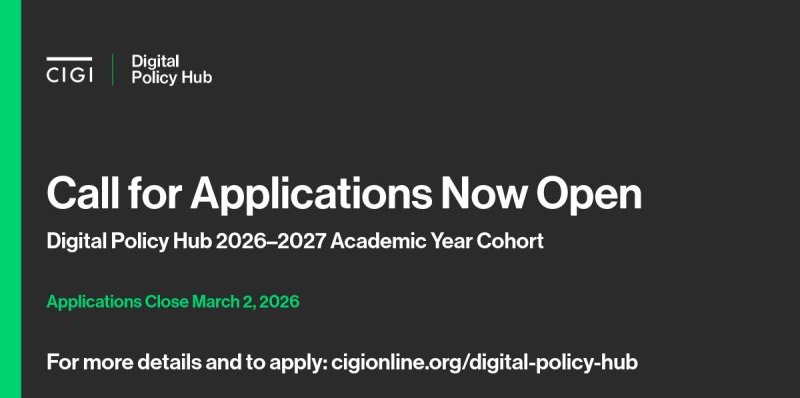
The Digital Policy Hub at CIGI is a collaborative space for emerging scholars and innovative thinkers from the social, natural and applied sciences. Here are the most recent working papers published by Hub fellows.

Halyna Padalko: “Lessons from Ukraine’s Information Defence for Democratic Resilience”

Rafael Morales-Guzman: “Digital Dollarization: Stablecoins and Canada’s Monetary Sovereignty”

Follow the links on the Hub webpage to learn more about the Hub scholars and their work.

In this commentary piece, Elena Yunusov argues that true AI sovereignty for a middle power like Canada lies not in isolation, but in mastering the global open-source ecosystems. Building on Prime Minister Mark Carney’s “third path” manifesto, Yunusov suggests that open-source AI offers the same transformative potential as the early open standards of the internet.

Alex Vronces argues that Canada’s newly proposed Stablecoin Act fundamentally breaks the sacred principle of “same activity, same risk, same regulation.” In this commentary, he argues that although stablecoins effectively function as “narrow banks,” the Canadian government has opted to regulate the technology through a brand-new framework overseen by the Bank of Canada, rather than applying existing banking laws.

Follow us
                         
© 2026 Centre for International Governance Innovation