Tech Diplomacy and Africa’s Digital Future

Influential research. Trusted analysis.

In this policy brief, Folashadé Soulé argues that tech diplomacy has become a vital instrument for African nations to advance their foreign policy goals and foster regional economic development. By building sovereign digital capabilities and engaging in global governance from a position of unity, African states can ensure they are no longer just passive recipients of technology but active architects of their own digital future.

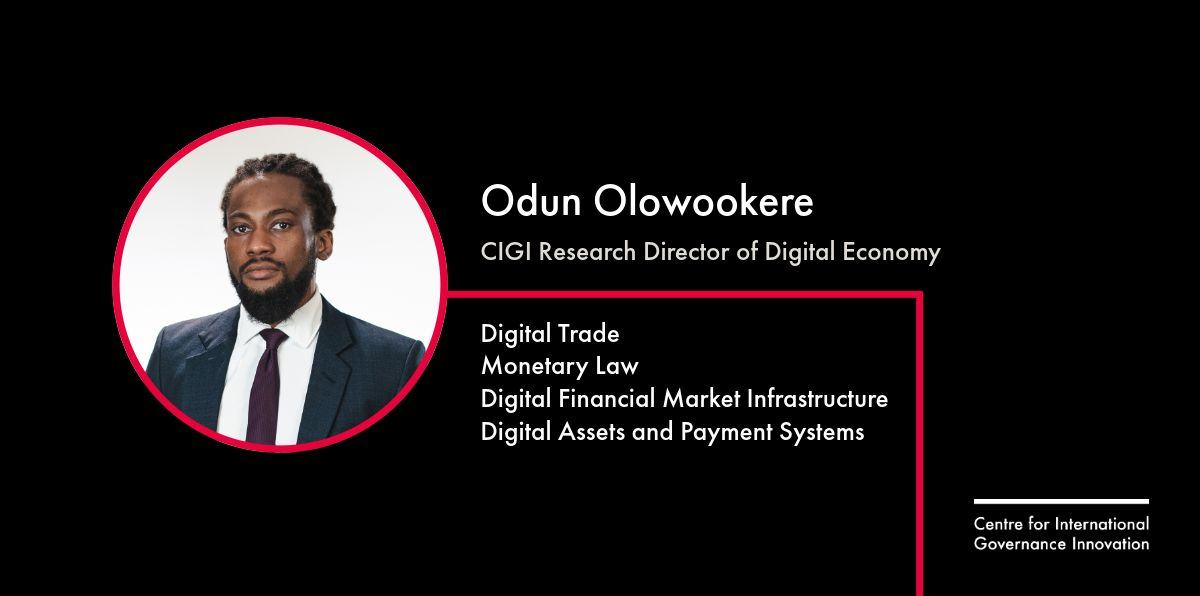
We are thrilled to welcome Odun Olowookere to CIGI as our new research director for digital economy! Odun’s professional experience spans key areas such as commercial litigation, corporate finance, financial transactions, energy infrastructure development regulation, fintech and banking regulation. With an interdisciplinary background in law and finance, Odun will focus on how technological change is reshaping money, monetary institutions and the global financial system.

A very warm welcome to Odun!

In this commentary, Thomas A. Bernes reflects on his decades within global economic institutions to explain why the era of American leadership is reaching a critical turning point. Bernes argues that the core of US power was once its willingness to bind itself to international rules. Today, as Washington pivots toward unilateral tariffs and exceptionalist military operations, that “rupture” in the rule of law is creating systemic instability.

Susan Ariel Aaronson and Michael Moreno warn in this commentary that the global race for automation is creating a dangerouseconomic catch-22.” The authors argue that artificial intelligence (AI) is fundamentally shifting comparative advantage from “cheap labour” to “intelligent systems,” a transition that favours large firms and countries with integrated research labs directly on their factory floors.

Recommended

In a recent interview with BNN Bloomberg, CIGI Distinguished Fellow Arif Lalani provided a sobering assessment of how escalating tensions in the Middle East are reverberating through the Canadian business landscape, describing the current situation as “worse in terms of lack of strategic consideration than the American invasion of Iraq.” Watch the full segment here.

The latest Global Expert Survey on the International Order and Relations between the Major Powers, conducted by The Genron NPO in cooperation with CIGI and 35 other think tanks, reveals a critical need for track-two diplomacy as “power-based approaches” increasingly strain global stability. CIGI President Paul Samson and several CIGI fellows played a central role in the survey’s development and the analysis of its findings. Read the full results.

In this commentary, first published by The Globe and Mail, Bessma Momani explains that the integration of AI into battlefield decision making is eroding the essential guardrails of international humanitarian law. As militaries move toward “agentic warfare,” the risk of catastrophic “hallucinations” and dehumanized killing increases exponentially. Without new global norms to trace accountability, Momami writes, we risk a future where wars “escalate...at machine speed” and escape human control entirely.

Alex He examines in this commentary, first published by Firstpost, how the “AI Supercycle” is triggering a structural crisis in the global semiconductor market. He warns that this bottleneck is a structural stress test for the global supply chain, complicated by geopolitical tensions and the sheer scale of compute-heavy generative AI.

Follow us
                         
© 2026 Centre for International Governance Innovation