The Past Year at CIGI

Influential research. Trusted analysis.

We invite you to look back at CIGI’s work in 2024–2025, a year marked by accelerating technological change, mounting geopolitical strain and growing uncertainty in the global order. As digital transformation continues to reshape economies, security and governance, CIGI fellows and contributors delivered timely research, policy insight and analysis on the challenges and opportunities facing international governance today.

“We are now 40 years into a new kind of economy, in which the basis of wealth and power is derived from the control of transformative technologies, as well as from ownership and control of valuable intellectual property, data and artificial intelligence (AI).” Read the message from Jim Balsillie, chair, CIGI Board of Directors.

“We now live in a low-trust, multipolar world, but the dust hasn’t settled on a new order yet. Despite obstacles, there are opportunities to halt fragmentation of the international system and to drive reform.” Read the message from Paul Samson, CIGI president.

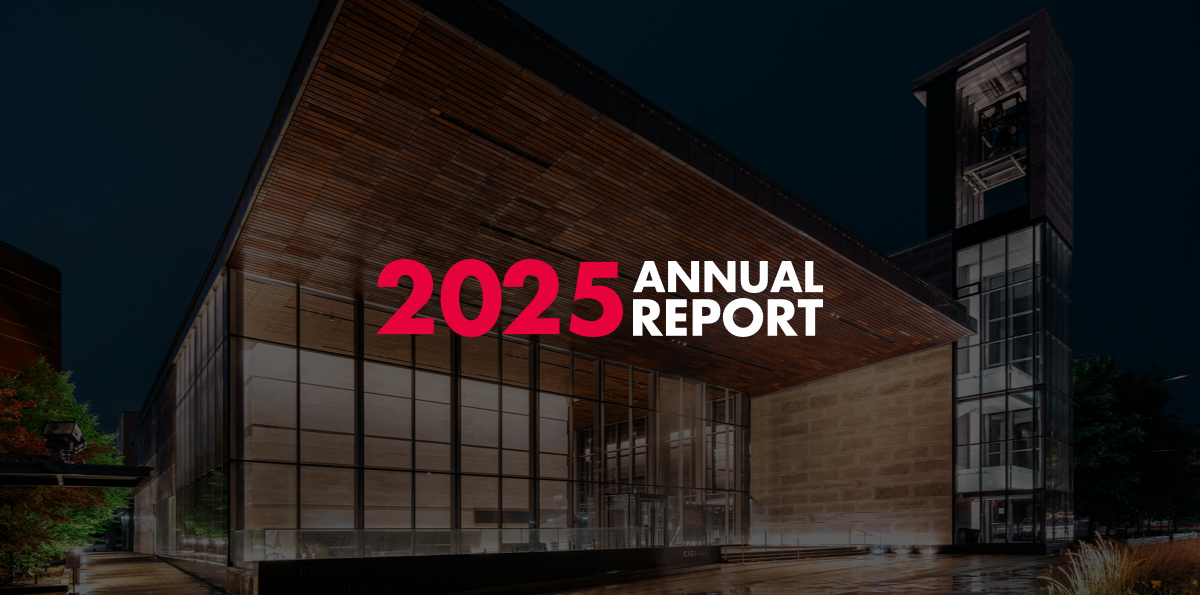
Explore CIGI’s interactive 2025 Annual Report to learn more about the ideas, research and policy engagement that shaped the year behind — and the path ahead.

Over the past year, CIGI played a visible role in shaping global policy debates at a time of intensifying geopolitical strain and rapid technological change. CIGI hosted the Think7 engagement group ahead of the Group of Seven (G7) Leaders’ Summit, producing 20 policy briefs and helping place quantum technologies on the G7 agenda for the first time.

Our research informed G7 discussions on AI-driven productivity and contributed to dialogues on digital assets, elections and foreign interference.

Across these efforts, CIGI advanced forward-looking analysis on global order, digital governance and emerging technologies while investing in the next generation of policy leaders through the Digital Policy Hub and in new public engagement initiatives such as the Policy Prompt podcast.

As we close out 2025, we extend our sincere thanks to our readers, partners and subscribers for engaging with and supporting CIGI’s work throughout the year. In 2025, CIGI advanced research on technology-facilitated gender-based violence, expanded analysis of digital assets in a deglobalized world and deepened engagement on Africa’s digital transformation.

Your continued interest and collaboration help ensure that independent, policy-relevant research remains a vital part of debates on international governance at a time of profound global change.

What shifts will be the most significant in shaping governance in 2026?

This new article brings together voices and perspectives from across CIGI in a lookahead at the new year. Here, they examine emerging pressures on global institutions, the digitalization of the global economy, Africa’s evolving political and digital partnerships, advances in AI and dual-use technologies, and the growing importance of cyber and space security.

Recommended

Recent US strikes in Venezuela underscore the new fragility of the current global order. In this report, authors Paul Samson, S. Yash Kalash, Nikolina Zivkovic, Tracey Forrest and Bessma Momani outline five possible futures, showing how shocks like these can quickly reshape international institutions and policies. Read the special report.

On Monday, Business Insider included Henry Gao’s comments in a roundup of insights from “the smartest people in foreign policy, business, and economics” on Trump’s raid on Venezuela. Gao argues that the raid signals a “brave new world of international law,” warning that the precedent set in Venezuela could reshape how great powers justify intervention elsewhere, including in Taiwan. Read the full article.

In a commentary piece, Gregory Makoff and Robert Kahn examine how Venezuela’s economic fragility leaves it exposed to external pressures. The authors argue that a regime change, paired with renewed engagement with international institutions, could stabilize the country and unlock billions in support. Read the full commentary.

The national security and intelligence advisor to the prime minister (NSIA) plays a pivotal role in safeguarding Canada’s interests. This paper traces the evolution of the office, the officials who have held it and how they coordinated across government to address emerging threats. As global risks intensify and traditional allies can no longer be taken for granted, complacency is not an option. Authors Adam Chapnick and Vincent Rigby outline lessons from history and propose ways to enhance the NSIA’s role in addressing the challenges ahead.

In this article, first published by The Globe and Mail, author Wesley Wark warns that Canada cannot wait while the United States retreats from global leadership. Wark calls for a bold, independent national-security strategy to safeguard Canadian values and interests. Read the full commentary to understand why taking decisive action now is critical to avoid falling behind.

Follow us
                         
© 2026 Centre for International Governance Innovation